Hello everyone! We are the Antelope Squadron of the Molfetta Scout Group 2, and today we'll be talking to you about one of the places we visited
Underground Canosa
The caves of Underground Canosa date back to the end of World War II, but they feature a complex structure divided into two older sections: one part dates back 300 years, while another can be traced to 500 years ago. The entire route extends over 2,000 square meters and includes passageways that have been gradually brought to light over time, with additional galleries extending beyond the areas currently accessible.
At the entrance of the cave, a skylight is visible, which once played a fundamental role: besides serving as the main access point, it allowed air circulation in the underground environment and was used for extracting tuff (calcarenite). During World War II, Canosa’s tuff was transported throughout Puglia, especially to cities heavily damaged by bombings such as Foggia, to support reconstruction efforts.

The cave is still used today as a place for wine fermentation; inside, you can find bottles and demijohns. The site also offers an experience, particularly for children, allowing them to create their own wine through a process that lasts months, even flavoring the mixture with special aromas and herbs.


The extraction activity was entirely manual: blocks of tuff were obtained using simple tools such as pickaxes. Only later, with the introduction of cutting discs, did open-pit quarries become more common, as they were considered more practical and efficient than underground excavation.
To facilitate the transport of materials, a tool called a “pulley” was used, positioned above the skylight, allowing the tuff to be lifted to the surface. Once extracted, the blocks were not yet ready for use: they were refined by specialized craftsmen who, using a small axe, smoothed and prepared them for shipment.


Inside the cave, there is also an unexploded bomb dating back to World War II. Made of steel, a very rare material at the time, it was later emptied, cleaned, and reused as a water container, effectively becoming a tank.
Originally, the cave was much smaller than it is today. For this reason, child labor was also widespread: the narrow and low tunnels made it easier to employ children in extraction work.


Among the most curious features of the site is an opening in the wall called the “lover’s leap.” According to tradition, there were once two separate caves; during excavation work, the workers (the so-called “capocarovana”) dug until the dividing wall collapsed, connecting the two spaces.


Another room in the cave collected all the waste material Made while processing the tuff. This room, 20 meters deep, was also entirely dug by hand, as can be seen from the pattern on the walls. However, climbing over the debris, workers discovered a small room adorned with two columns; it is believed this space was used as an “office” by the capocarovana, who coordinated and monitored extraction activities from there.
The site is enriched by numerous artistic works created over time by the elderly owner. Among these are bas-reliefs carved directly into the tuff, the result of a creative process that began with images or books used as references: the artist would sketch the design with charcoal on the stone and then carve it, bringing the forms out of the material. This technique can be seen in a room where, still in charcoal, the figure of a pope is depicted, and on the adjacent wall, the completed image of Canosa’s patron saint, Saint Sabinus. The pope remains unfinished because, while the artist was creating it, visitors would interpret which pontiff it represented; therefore, the artist chose to leave it open to interpretation.


Within the underground space, there are also sculptures and representations inspired by foreign artistic influences known to a family member of the sculptor, including Spanish influences.

Particularly evocative is a room dedicated to a dear friend of a family member, portrayed on one of the walls for her bachelorette party. The space is enriched with sculptures and original artistic compositions.
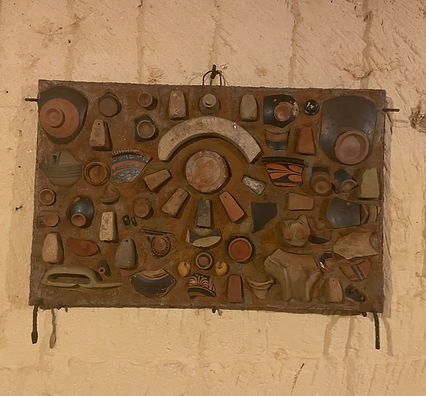
The artworks in this room were created by pouring cement onto surfaces and applying fragments of ceramic recovered near the family home. Some elements also recall handcrafted structures and reproductions made with the collaboration of master artisans, contributing to a unique decorative ensemble.



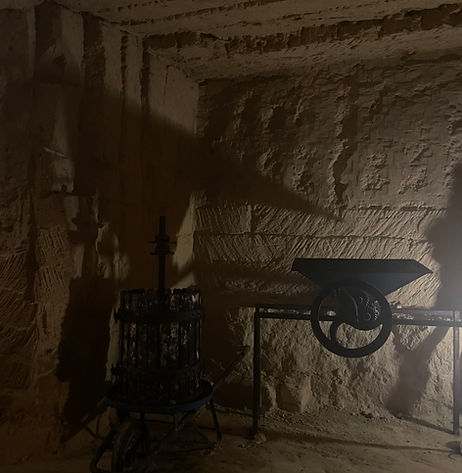

In the section dating back 500 years, one can immediately notice a contrast with the more recent part: the walls are divided horizontally by a line, below which the surface appears darker due to flooding caused by heavy rains, leaving a permanent mark.
