Hello everyone! We are the Antelope Squadron of the Molfetta Scout Group 2, and today we'll be talking to you about one of the places we visited
Trullo Caves
The Trullo Caves, located in Putignano, extends for a total length of about 3,000 meters, and its discovery happened around 1931. At that time, excavation works were underway to build the town’s sewer system when, suddenly, a sinkhole opened in the ground and a hammer fell inside it. The sinkhole now corresponds to the large natural entrance through which the cave complex can be accessed. Later, steps were constructed to create the spiral staircase that allows visitors to descend safely into the cavity. Even today, from the very first step, visitors are immediately struck by the vastness and beauty of the cave. After its discovery, four years of work were required to build all the infrastructure necessary for tourist visits: the spiral staircase, the internal paths, and the monumental trullo built on the surface. The trullo was added later to enhance the entrance and make it more recognizable to the public. The cave was officially opened in 1935. This date is particularly significant because at that time there was only one tourist cave in Italy. The Trullo Caves therefore became the second tourist cave in the country and the first in Apulia. To highlight the importance of the inauguration, the King of Italy, Umberto II of Savoy, also attended the ceremony.


Caves form over millions of years through a process of rock transformation: water infiltrates in the underground and slowly dissolves the minerals present in limestone. Drop by drop, this process contributes to the creation of enormous underground cavities. In the same way, the characteristic structures of caves also originate: stalactites and stalagmites.

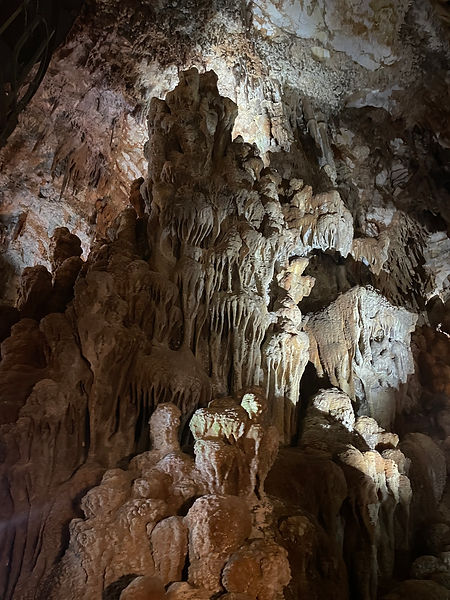
Stalactites develop from the ceiling downward thanks to dripping water. When a drop remains on the wall or the ceiling for a certain time, it deposits a small amount of minerals which, crystallizing over time, form a concretion. Deposit after deposit, stalactites gradually grow. From the same drop that falls to the ground, a stalagmite forms instead, growing upward from the floor. Stalactites and stalagmites are almost always aligned with each other and sometimes eventually meet, forming real columns. The largest ones are called “pillars” because they give the impression of supporting the entire cave. Among the most unusual formations are the so-called “sails,” also known as “ham slices.” These are flat stalactites that, instead of developing vertically, follow the inclination of the rock, forming structures that resemble sails. The largest one in Europe is located here: it is almost three meters wide, continues inside the wall, and over time has slightly shrunk because the gravel is not very heavy.


One of the most surprising features of this cave is its position: in some points it lies only nine meters below the surface, which is quite rare. In most limestone caves, cavities are found hundreds of meters deep. This is because water must dissolve minerals while passing through several layers of rock before forming stalactites and stalagmites. In more superficial cavities there is usually empty space, but such developed formations are rarely found. Here, however, the limestone is extremely rich in formations, and it is still not entirely clear how the water managed to pass through such thin rock layers, sometimes little more than one meter thick, dissolving such a large quantity of minerals and creating all these concretions. Looking upward, you can even see two black tufts: these are the roots of the palm tree located at the entrance of the cave, visible on the surface.
Another distinctive characteristic is the color of the formations, which tends toward red. This shade is due to the presence of minerals such as iron oxide and bauxite, both very common in the Apulian territory, which crystallize on calcium carbonates. Because the cave is very close to the surface, water does not always have time to filter completely. However, since it is a vertically developed cave that descends to about 20 meters deep, a gradual change in color can be observed: the formations become progressively whiter, as the water, filtering for longer, releases the heavier minerals. From a mineralogical point of view, the concretions may appear shiny, almost like precious stones such as rhinestones or emeralds, but in reality they are crystals of calcium carbonate. This compound, like common table salt, has a crystalline structure at the microscopic level that reflects light, which is why the surfaces appear sparkling. In some chambers, broken stalactites reflect light very intensely: they are often mistaken for quartz, but they are actually always calcium carbonate.


In one of the highest points of the cave there is an area where, during rainfall, the greatest dripping occurs. Here are the smallest stalactites in the entire cave, only a few centimeters long. This indicates that they formed relatively recently: it is estimated that about one centimeter of growth corresponds to one hundred years. In this area several “natural sculptures” have been identified, such as the so-called “Angel Column,” which has a natural capital and small protrusions resembling the profile of an angel, and a formation on the back wall that resembles the head of an elephant. With a bit of imagination, many visitors recognize other images: in one particularly observed spot, some people see the face of Homer Simpson or the Grinch.


At the deepest point of the cave, about 20 meters underground, the walls are covered with a material called “popcorn.” These are crystals of aragonite. From a chemical point of view, aragonite is also composed of calcium carbonate, just like stalactites and stalagmites, but it forms under different chemical conditions that give it this particular morphology. Initially these structures appear like soft clusters of crystals, but over time, because they are fragile, they round off and take on an appearance similar to popcorn. In this area the color of the formations is noticeably whiter because the water, filtering through a thicker layer of rock, has lost heavier minerals such as iron oxide and bauxite, resulting in water composed almost entirely of pure calcium carbonate. However, the color does not depend only on depth but also on the specific location within the cave. An example is the last chamber, called the “Golden Cave”: although it is at the same level, it shows an intermediate shade between the deep white and the red observed near the entrance. All these characteristics make this cave an extraordinary and rare environment within the panorama of limestone caves.


